Agent conversations
An agent (Claude Code, Codex, an app of your own) sends its whole conversation to the model with every turn. Quena links each call to the call it continues and puts the calls of one run together as a conversation. For each conversation it shows what changed from one call to the next, why the provider's prompt cache missed, where tokens go to waste and what fills the context. How to get an agent's traffic into Quena is on the overview.
The Agents panel
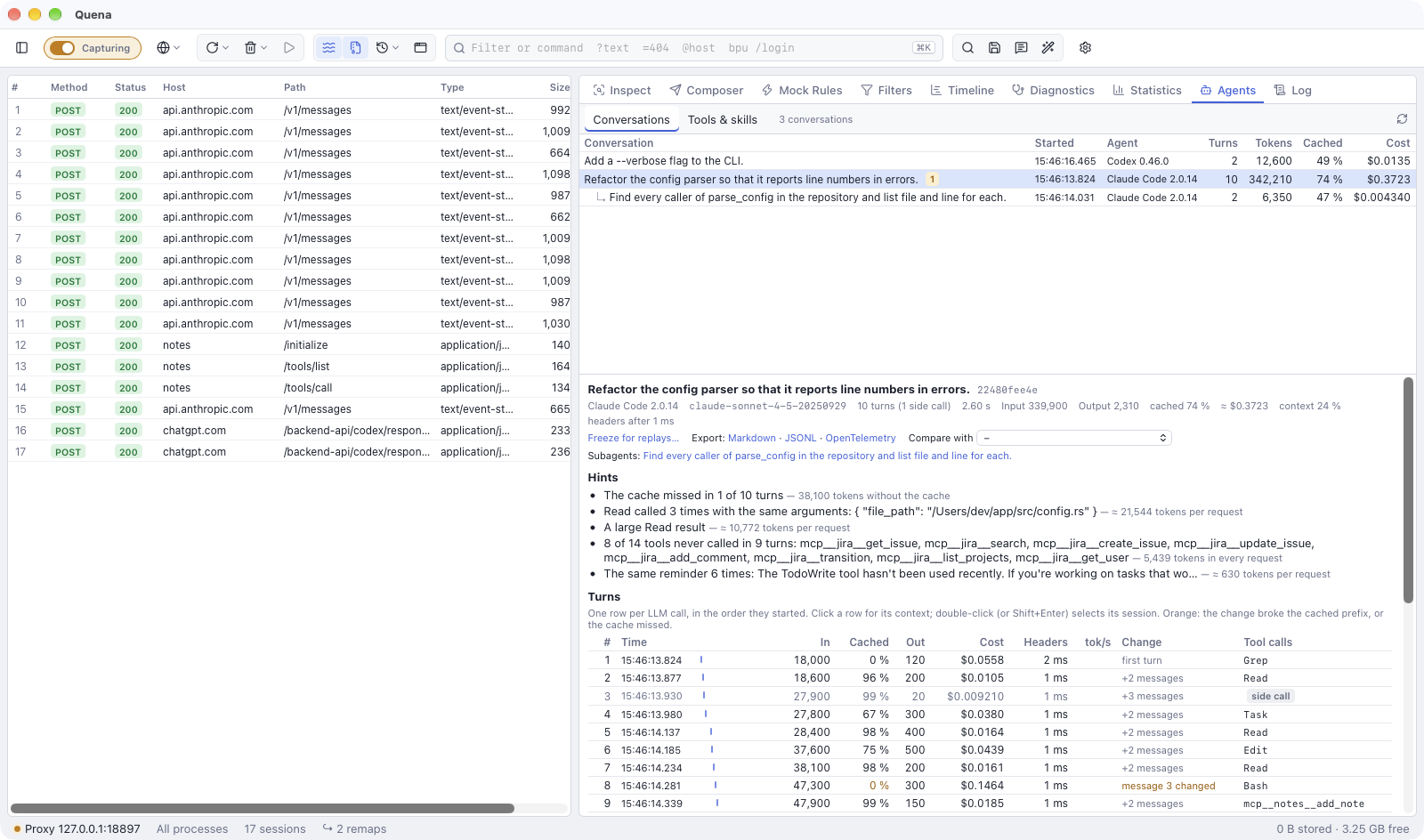
View → Agents, the tab Agents in the right pane or Show conversation in the LLM view opens the panel. Its tab Conversations lists the runs, newest first; the tab Tools & skills sums up tools and skills. The panel is computed from the capture when it opens and updates as calls arrive; the refresh button computes it again. Calls still running are read once they are done, and conversations of removed sessions go with them.
| Column | What it shows |
|---|---|
| Conversation | The title: the first prompt of the user, without what the agent adds around it (reminders, instruction files, environment). A badge counts the turns where the cache missed, a red one the calls that failed. A subagent is listed under the conversation that started it. |
| Started | When the first call started. |
| Agent | The agent that sent the first call, by its User-Agent (Claude Code 2.0.14, Codex 0.46.0 …; the first word of the User-Agent for clients Quena does not know, the provider when there is none). |
| Turns | All LLM calls of the conversation, side calls, variants and answers from the agent cache included. |
| Tokens | Input (cached tokens included) plus output, of the calls that spent tokens. |
| Cached | The cached share: input tokens read from the provider's prompt cache divided by all input tokens. Answers from Quena's agent cache count in neither. – when the provider reported no cache reads and no turn missed. |
| Cost | The estimated cost of the turns whose model has a known price (Costs). |
Double-click a row (or Shift+Enter) to select the conversation's first session in the list. Choose a conversation to see, at the top, its key, agent and models, the number of turns (with side calls and answers from the agent cache), the time from the first call's start to the last call's end, input and output tokens, the cached share, the cost, how much of the model's context window the last request filled, the median latency, refused calls and retries. Below that are Freeze for replays…, Export: and Compare with (see Optimising agents), the conversation that started it and its subagents, the hints, the turns and the context of the last request.
Turns
One row per LLM call, in the order they started (long runs show the first 1,000; Show all … turns shows the rest):
- # and Time; pointing at the number names the turn it continues.
- A bar on the run's time axis: when the call ran and how long it took.
- In (input tokens, cached ones included), Cached (the share read from the prompt cache), Out, Cost.
- Headers: the time from sending the request to the response headers (with connecting, on a new connection). tok/s: output tokens per second of a streamed answer, from its first byte. See Latency and rate limits.
- Change: how the request differs from the call it continues, which need not be the
row above (a side call or a subagent may have run in between):
first turn,+2 messages,sent again(the same messages, e.g. a retry),message 12 changed,system prompt changed,tools changed(also when only their order or a schema changed),settings changed: thinking,model changed. Changes that break the provider's cached prefix are orange. A status of 400 or more shows as a red badge. - Tool calls: the tools the answer called. A side call, a call no later turn continues (Claude Code's prompt suggestions and summaries, a variant), is marked side call. An answer from Quena's agent cache is marked agent cache and costs nothing.
Click a row for that turn's context (the same as in the LLM view); double-click it or press Shift+Enter to select its session. Pointing at a row shows the cache verdict.
Why the cache missed
Providers keep the start of a request for a while and charge it at a fraction of the price
the next time: Anthropic for 5 minutes, or 1 hour when the request asks for it ("ttl": "1h");
OpenAI for 5 to 10 minutes, or 24 hours with prompt_cache_retention: "24h".
A turn counts as a cache miss when the tokens it read from the cache are less than half of what could have come from there: the input of the call it was judged against, at most this call's input. That call is the one it continues, or, if that one used no tokens or failed, the nearest before it that did. Turns where that amount is below the shortest prompt the provider caches (see below; 1,024 tokens for the other APIs) are not judged. Quena judges only where the provider reports cached tokens: for Anthropic's Messages API always (also on Vertex AI and Bedrock), for the other APIs once a turn of the conversation read from or wrote to the cache.
A missed turn names the reasons it can see:
| Reason | What happened |
|---|---|
| Message n of m changed | An earlier message differs: everything from it on is new to the cache. |
| The system prompt changed | Claude Code's attribution block does not count. |
| The tool definitions changed | Tools added, removed or changed, or only their order. |
| Settings the cache depends on changed | thinking, tool_choice, the reasoning effort (reasoning.effort, reasoning_effort), output_config, prompt_cache_retention, or the anthropic-beta header. |
| The model changed | Each model has its own cache. |
| Cache expired | More time passed since the end of the call it was judged against than the cache's lifetime: 24 hours with prompt_cache_retention 24h, 1 hour with Anthropic's ttl 1h, else 5 minutes. |
| No cache_control breakpoint | Anthropic caches only prefixes the request marks with cache_control. |
| Reason not known | None of the above: another server answered, the provider evicted the entry, or it does not report cached tokens. |
A request to Anthropic's Messages API that sets cache_control but is shorter than the
provider caches gets its own note, Marked for caching, but shorter than … tokens: 1,024
tokens, 2,048 for Claude 3 Haiku and 3.5 Haiku, 4,096 for Opus 4.5 and later, Haiku 4.5 and
Sonnet 5. Other APIs get no such note.
Hints where tokens go to waste
The hints look at the conversation's last request on its main line (it carries the whole history) and at the tools all turns called. Each names the tokens it costs, largest first:
| Hint | When it shows | Tokens |
|---|---|---|
| The same call repeated | A tool called more than twice with the same arguments. | What the later results add. |
| The same tool result more than once | An identical result of 50 tokens or more is in the context twice or more (and no repeated call explains it). | The extra copies. |
| A large result | Results of 8,000 tokens or more; the five largest. | The result. |
| The same reminder again and again | A note the agent adds (<system-reminder> …) of 100 characters or more, three times or more. |
The extra copies. |
| Tools never called | Tools offered in the last request that no turn called, once the conversation has three or more turns besides side calls. | Their definitions, in every request. |
| The context fills the window | The last request's input is 70 % or more of the model's context window. | The input. |
| Calls refused | Calls answered with 429, 529 or 503, and how many were sent again unchanged after a failure. | Waiting time instead of tokens. |
| Close to the rate limit | The latest rate limit the provider reported has less than 10 % of its tokens left. | – |
| The cache missed | Turns that were cache misses (see above). | The tokens processed again without the cache. |
Token counts in the hints are estimated from the text and scaled to the input the provider reported, as in the context map.
What fills the context
Context of the last request (and the context of a turn you click) shows a map of the request's input: the system prompt, each tool definition, the provider's tool prompt, instruction files (CLAUDE.md, AGENTS.md, by path), the list of skills, reminders, the environment (working folder, open files, output of commands the user ran), a compaction summary, user and assistant messages, thinking, tool calls and tool results by tool, and images (also those in tool results).
- The slices are estimated from the text the way tokenisers split it, then scaled so that they add up to the input tokens the provider reported.
- Two slices have fixed amounts and are not scaled: each image counts 1,600 tokens (the size of an image is not known), and Anthropic's tool prompt, the system prompt Anthropic adds when a request offers tools, counts 346 tokens.
- History the provider keeps (OpenAI Responses with
previous_response_id) shows as a slice of its own, History kept by the provider, when the reported input is well above what the request carries. - The context window comes from
contextin yourllm-prices.json, else from the fetched LiteLLM list, else from the model's family. Claude models count with a window of 1,000,000 tokens once a request was larger than their usual window (they run with the 1M context then).
Latency and rate limits
Each turn shows the time from sending the request to the response headers (on a new
connection with connecting) and, for streamed answers, the output tokens per second from the
answer's first byte; the conversation shows the medians of both. A turn refused with 429
(rate limit) or 529 / 503 (provider overloaded) shows its status. The rate limits a response
reports (anthropic-ratelimit-*, x-ratelimit-*, retry-after) show when pointing at the
status or the tokens per second. Retries counts calls sent again unchanged after the call
before them failed.
The Context section of the LLM view
The LLM view shows the same for one call under Context: its turn in the conversation (Show conversation opens the panel), the context map with the share of the context window, the change from the call it continues (the message that changed, before and after) and the cache verdict.
How calls are put together
Each call is linked to the call it continues:
- the request Claude Code names as its previous one (in its attribution block), when the two share messages or the same group (below);
- the response that a
previous_response_idnames (OpenAI Responses), or the message that Claude Code'sthread.previous_message_idnames (its message threads); such a call carries only its new messages, so it counts as+n messages, a system prompt or tools it leaves out count as unchanged, and the history for the hints and the context map is put together from the calls before it; - else, among earlier calls of the same group, the one whose messages this call carries furthest. The latest call it carries whole wins; a call that shares only a start must share at least half of that call's messages.
A group is the agent's session, the first 200 characters of the system prompt and the
first prompt of the user. The agent's session is Claude Code's session id
(X-Claude-Code-Session-Id, or session_id in metadata.user_id), Codex's session or
thread (session_id, thread_id headers) or a prompt_cache_key. What agents add around the
user's words (<system-reminder>, AGENTS.md, <environment_context>, slash-command caveats)
and Claude Code's attribution block do not count. Without a session id, calls more than
30 minutes apart are not linked by their messages alone.
Calls linked that way form a conversation. Its main line runs from its newest call back through the calls each continues; a call off the main line that no other call continues is a side call.
A conversation is a subagent of another when:
- the agent names the parent session (Claude Code's
parent_session_idinmetadata.user_id, Codex'sx-codex-parent-thread-id): the latest conversation of that session started before it; - else its first prompt (the first 60 characters, at least 20) appears in the arguments of a tool call of another conversation in the 2 hours before it started (Claude Code's Task tool, for example);
- else the agent marks it as a subagent (Claude Code's
cc_is_subagent, Codex'sx-openai-subagent) and another conversation of the same session started before it.
Each conversation has a key of 10 hexadecimal characters, made from its group and the session number of its first call. Keys are stable within one capture. The same calls loaded again from an archive can get other keys; the flags are brought up to date when the Agents panel opens.
Columns, grouping and filters
Each call gets the flag x-quena-llm-conv with its conversation's key:
- column Conversation (right-click the column headers);
- Group by → Conversation (agent run);
- filters
conv == 22480fee4e(alsoconversation) andagent ~ "claude code"(see syntax).
The columns LLM, Tokens, Cost and Agent are described on LLM traffic.
Export a conversation
Export: in a conversation writes it to a file you choose. Only that conversation is written; its subagents are exported on their own.
| Format | What it holds |
|---|---|
| Markdown | A header (agent, models, turns, tokens, cost, key) and the hints in words, then each turn: model, tokens and cost, the cache notes in words (Cache missed: … tokens were processed again without it), the system prompt (first turn only), the messages the turn added (tool calls and results included) and the answer. Each part is cut at 4,000 characters. To read or share. |
| JSON lines | One line per turn, for evaluations: conversation, turn, session, started, side, the change (diff), the cache notes, and call, the LLM call as the LLM view takes it apart. call carries only the messages this turn added (messagesBefore says how many came before), and the system prompt and tools only when they differ from the line before. |
| OpenTelemetry | Spans after the OpenTelemetry GenAI semantic conventions as OTLP JSON: a span for the run (invoke_agent) and one per call (chat <model>) with provider, model, tokens, cached tokens, finish reason and the names of the tools called. No prompts or results. Trace and span ids are derived from the conversation's key and start, so exporting the same run again keeps them. To load into Langfuse, Phoenix or another tracing tool. |
The file is written as it goes, a call at a time, and put in place at the end. Texts are taken as the LLM view has them, so a part longer than 200,000 characters is shortened.
Privacy of exports
Markdown and JSON lines hold the full content: the system prompt, the user's prompts, tool arguments and results (file contents, command output) and the answers, including any secrets in them. Nothing is redacted. Read the file before you share it. The OpenTelemetry export holds no content, but it does name the agent, the models and the tools.
For AI agents
Over Quena's MCP server:
list_conversations: the conversations with title, agent, models, turns, side calls, tokens, cached share, cost, cache misses, refused calls, retries, latency and context size; subagents name their parent.limit(default 100) andoffsetpage through them.get_conversation: one conversation by key, with its turns (the change, the cache verdict, rate limits), the hints, what filled the last request and its subagents.limit(default 500 turns) andoffsetpage through long runs;turnsTotalandturnsOffsetsay where the page is.get_context: what fills one call's input, its turn and the cache verdict.
Unless agents may see secrets, titles, the text in hints and the changed message are redacted with the credentials preset of the sanitizer first.